If you’re working in electrical protection, chances are you’ve come across T1+T2 12.5kA surge protective devices (SPDs) at some point. As a supplier of these units, I get a ton of questions about their rated voltage—it’s one of the first things someone new to surge protection asks, and even seasoned electricians sometimes mix up the numbers. Let’s break this down simply, no jargon overload, and explain why it matters, what the right rated voltage is, and how it fits with a 12.5kA T1+T2 unit. T1+T2 12.5KA Surge Protective Device
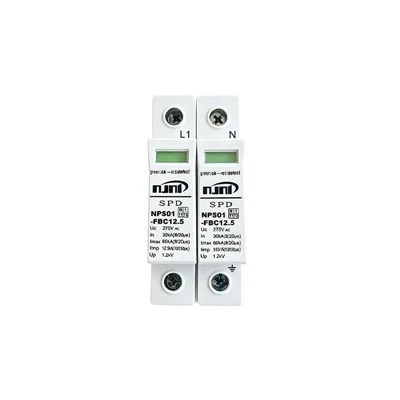
First, let’s clear up the basics: T1 and T2 are surge protection categories defined by IEC 60364-5-53, the standard for electrical installations. T1 is for direct lightning strikes (or very close ones, where huge surge currents hit the incoming main line), and T2 is for indirect strikes or switching surges further downstream. A T1+T2 combination means this one device handles both, which is super useful because it cuts down on installation time compared to using two separate units for T1 and T2. The 12.5kA number is the nominal discharge current—how much surge current the device can handle once. So now, the rated voltage: that’s the maximum continuous AC voltage the SPD can withstand without breaking down or failing, right? If it’s too low, the SPD will trigger all the time, even on normal line voltage, which wears it out fast. If it’s too high, it won’t divert surges when you need it most.
Now, here’s where it gets specific for T1+T2 12.5kA units. Most of these devices are made for low-voltage electrical systems, which are the ones we use in homes, offices, factories—usually 230V or 400V three-phase. Wait, but the rated voltage isn’t just the line voltage; there’s a thing called the maximum continuous operating voltage (MCOV), which is directly tied to the rated voltage we talk about. For T1+T2 SPDs with 12.5kA discharge current, the standard rated voltage for single-phase systems (like most homes) is 275V AC, and for three-phase systems, it’s 440V AC. Let me explain why that’s not just a random number. Normal line voltage is 230V, right? So if the SPD had a 230V rating, it would see that 230V every day, and even a tiny fluctuation above 230 would make it start conducting, which is bad. The 275V is a buffer—it’s high enough to stay off during normal voltage, but low enough to trigger fast when a surge hits. For three-phase 400V systems, 440V is the buffer.
I know some guys will ask, “Can I use a 400V rated unit on a single-phase 230V line?” Technically maybe, but it’s not right. A 400V rated T1+T2 12.5kA SPD won’t trigger quickly enough when a surge comes because its threshold is too high, so it might not divert the surge, and that’s how you get damaged appliances or wiring. That’s why matching the rated voltage to your system is non-negotiable.
Let me also talk about how the 12.5kA number plays into this. T1 SPDs have higher discharge currents usually, but a T1+T2 hybrid at 12.5kA is rated for Iimp (impulse current) of 12.5kA for T1, and In (nominal current) of 12.5kA for T2? Wait no, let’s get that straight—In is the current the device handles repeatedly, Iimp is the single big surge for T1. A 12.5kA T1+T2 unit means Iimp is 12.5kA, which is enough for most residential and small commercial direct strike scenarios. The rated voltage is tied to the voltage class of the system, so if you have a 230V single-phase line, the MCOV (which is part of the rated voltage specification) is 275V. That’s not just me saying this—this is what IEC 61643-11, the standard for low-voltage SPDs, specifies for these product categories.
Now, why is this important for you as someone looking to buy? I see a lot of bad installations where people grab any T1+T2 12.5kA unit and don’t check the rated voltage. Last year, a small café in my area installed a unit with 400V rated voltage on their 230V single-phase line, and when a storm hit, the surge wasn’t diverted—they lost their espresso machine, their POS system, and had to rewire part of their kitchen. That’s a costly mistake. The right rated voltage would have saved them.
Another point: some manufacturers might list “rated voltage” as just the line voltage, but you need to look at the MCOV. For T1+T2 12.5kA units, the MCOV is almost always 275V for single-phase, 440V for three-phase. If a supplier is advertising a T1+T2 12.5kA unit with 230V MCOV, that’s actually for a different application—probably a T2 only unit, not a hybrid T1+T2. So that’s a red flag.
Let’s also clear up a common confusion: peak voltage vs. rated voltage. Line voltage is RMS (root mean square), so 230V RMS is about 325V peak. A 275V rated MCOV is higher than the normal peak, which is why it works—so normal voltage never crosses into the SPD’s conduction zone. If the peak goes higher, like from a surge, the SPD kicks in immediately. The 12.5kA current rating means it can handle that surge without failing, so you don’t have to worry about it burning out on a big strike.
As a supplier, I test every T1+T2 12.5kA unit we send out to make sure the rated voltage is exactly what it’s labeled. We don’t cut corners here—we know if we sell a unit with the wrong voltage spec, it’s not just a bad product, it’s a risk for our customers. We’ve had customers come back after that café story, asking for replacements because their old units were mismatched. That’s why we make sure to note in every product description that the rated voltage is 275V for single-phase, 440V for three-phase, paired with 12.5kA discharge current.
Wait, is there any case where a T1+T2 12.5kA unit would have a different rated voltage? Yeah, if it’s for a different system—like 120V in North America. For 120V single-phase systems, the rated voltage would be 150V MCOV, right? That’s the standard for North American low voltage. So it all depends on your region’s line voltage. But if you’re in Europe, most of us use 230V, so 275V is your rated voltage. If you’re in Australia, same thing—230V line, 275V rated for T1+T2 12.5kA.
Let me give you a quick example: if you’re installing a new SPD in your home’s main electrical panel, which is 230V single-phase, you need a T1+T2 SPD with 12.5kA Iimp and a rated voltage (MCOV) of 275V. If you’re doing a three-phase industrial setup at 400V, you need 440V rated. Using the wrong one is the easiest way to get no surge protection when you need it.
I get it—when you’re ordering, you’re looking at specs like current rating, type (T1, T2, hybrid), and sometimes you skip over the voltage part. But it’s the most critical spec after the current rating. A T1+T2 12.5kA unit is only as good as its rated voltage. If that’s off, it’s just a surge damag with a fancy label.
Now, if you’re in the market for a reliable T1+T2 12.5kA surge protective device, don’t just pick the cheapest one or the one with the right current. Double-check that the rated voltage matches your system. We make sure all our units are tested to IEC standards, so you don’t have to worry about mismatched specs. Our team can help you figure out which rated voltage you need, whether it’s 275V for your home or 440V for your warehouse. We’ve worked with electricians, builders, and even home owners, so we know what questions to ask to get the right unit for your setup.
If you’re tired of dealing with SPDs that either don’t work when storms hit or wear out too fast because of wrong voltage, reach out to us. We can walk you through the specs, confirm the rated voltage for your system, and make sure you get a T1+T2 12.5kA unit that’s built to last. Don’t take chances with your electrical gear—surges are unpredictable, but your protection doesn’t have to be.
T1+T2 12.5KA Surge Protective Device Reference: IEC 61643-11:2019, Low-voltage surge protective devices – Part 11: Surge protective devices connected to low-voltage power systems – Requirements and test methods; IEC 60364-5-53:2020, Low-voltage electrical installations – Part 5-53: Selection and erection of electrical equipment – Surge protective devices.
Nanjing Ningpu Lightning Protection Equipment Manufacturing Co., Ltd.
As one of the most professional T1+T2 12.5ka surge protective device manufacturers and suppliers in China, we’re featured by quality products and good price. Please rest assured to buy customized T1+T2 12.5ka surge protective device made in China here from our factory. Also, pricelist is available.
Address: Building 1, No.20 Shengyuan Road, Lishui Economic Development Zone, Nanjing City, Jiangsu Province, China
E-mail: 3796023563@qq.com
WebSite: https://www.npspd.com/
