Hey everyone, let’s talk about something that’s basically the unsung hero of all the wedge wire screen projects I’ve worked on in the last 8 years at our shop—seriously, I can’t tell you how many customers have messaged me last minute panicking because they don’t get what a wedge wire screen slot size chart even is, and that’s the exact reason for this post. If you’re here scrolling because you’re deep in a water filtration, mining, or food processing project and you’re tired of guessing slot sizes, this is your sign to stop overcomplicating it. Wedge Wire Screen
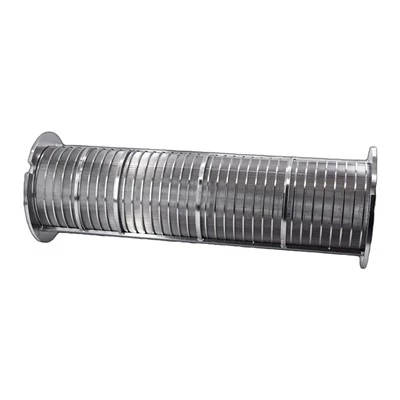
First off, let’s keep this real. I don’t need to hit you with a bunch of stuffy industry jargon that makes your eyes glaze over, especially since most folks who ask me about this aren’t engineers—they’re guys out in the field, small business owners, or even people planning a backyard well upgrade who’ve heard wedge wire screens are way better than perforated pipe. A wedge wire screen slot size chart? It’s not some secret government document, I promise. Let’s break it down like we’re sitting at my workbench with a cold soda, no tech bro nonsense allowed.
At its core, a wedge wire screen slot size chart is a simple, organized reference that tells you the exact gap (we call that the slot, duh) between the individual V-shaped wires that make up a wedge wire screen. Those wires are welded to support rods, right? The big thing that makes wedge wire screens different from other types of screens is that the slot is uniform—no weird gaps that widen or narrow over time, which is why they’re used for everything from sifting gravel to filtering beer (yes, really, I supplied a batch to a craft brewery in Portland last year).
Now, why does this chart actually matter? Let’s be honest—if you pick the wrong slot size, your whole project goes south. I’ve seen it happen more times than I can count. Guy comes to me needing a screen for a residential well, says “just give me a standard one.” I give him a 0.010-inch slot (that’s 0.254 mm for my metric-using friends, we’ll circle back to units in a sec). A month later, he’s back, furious—his well’s pulling in sand, and the pump is already clogged. Turns out his local aquifer has sand particles that are 0.012 mm big, so a 0.010 slot is way too small? Wait, no, wait—wait, let’s get that right: the slot has to be smaller than the particles you don’t want getting through. Oh right, so that guy’s mistake was not checking the slot size chart first. He got a “standard” screen that was too big, and now he’s stuck replacing his pump. Ouch. That’s exactly why this chart isn’t just a “nice to have”—it’s non-negotiable.
Let’s talk about how these charts are set up, because a lot of people get confused by the different units we use. First, we’ve got imperial units (inches, thousandths of an inch) and metric (millimeters, sometimes micrometers). The chart will usually have both, but I always tell customers to go with whatever unit their material specs are in. For example, if you’re working in the mining industry, they’ll talk in thousandths of an inch a lot—like 0.015” or 0.020”. Food processing folks? They’re more likely to use millimeters, since that’s standard for food safety measurements. Then there’s the actual slot dimensions: the chart lists every possible slot we can make, right? We can do slots as tiny as 0.008” (0.203 mm) for super fine filtration, up to like 0.500” (12.7 mm) for dewatering coal or gravel. The chart also usually has other specs you might need, like the wire thickness, the rod spacing, and the overall screen size, but the star of the show is always that slot measurement.
Wait a second—can’t you just measure the slot with a caliper? Sure, if you have a brand new, unused piece of screen. But here’s the thing: when screens are being manufactured, the slot size is precisely set during the welding process, but when you’re talking about ordering a screen for your project, you need to know the slot size before you buy, not after it shows up. That’s where the chart comes in. It’s a pre-made reference that tells you exactly what each screen option has for a slot, so you don’t have to guess. Also, a lot of industries have standards—like the American Water Works Association (AWWA) has specific slot size requirements for well screens, so the chart will align with those standards too. I always make sure our charts have that, because customers don’t want to buy a screen that doesn’t meet local regulations.
Let’s run through a real example, something most people can relate to. Say you’re starting a small home brewery, and you need a screen to separate the spent grain from your wort (that’s the sugary liquid before it becomes beer). The spent grain particles are roughly 0.5 mm to 2 mm big, right? So you need a slot size smaller than that, something like 0.35 mm, to catch all the grain but let the wort flow through. If you check our slot size chart, you’ll see that’s a common size we stock, or we can custom make it. If you just grabbed a random screen from the hardware store, it might have a 1 mm slot, and all your grain would slip through, leaving you with cloudy beer and a huge mess to clean up. That’s the kind of headache the slot size chart is built to prevent.
Another common use case: construction aggregate. If you’re sorting gravel into different sizes—like ½-inch, ¼-inch, etc.—you’d use a vibrating screen with a specific wedge wire slot. Let’s say you want to separate ¼-inch gravel from smaller particles. The slot size here would be around 6 mm (0.236 inches), right? The chart would tell you exactly what size to order for that application, so you don’t end up with gravel that’s either too big or too small. I’ve had guys in the construction industry come to me all the time saying they used the wrong slot size on their first screen, and now they have a pile of mis-sized gravel that’s useless. Total waste of time and money, all because they skipped the slot size chart.
Now, let’s address some myths I hear all the time. First myth: “All wedge wire screens have standard slot sizes, so I don’t need a chart.” No way. Like I said earlier, we make slots from 0.2 mm up to over 12 mm, and every industry has its own standards. What works for a well won’t work for a brewery, and what works for gravel won’t work for wastewater treatment. Second myth: “I can just measure the slot on an existing screen to get the size.” That works if the screen is in perfect condition, but if it’s been used, it might have expanded due to pressure, or bent from being moved, so the measurement won’t be accurate. The chart is based on the manufactured slot size, which is the one you need to match when replacing or ordering new screens. Third myth: “Custom slot sizes are super expensive.” Yeah, they used to be, but not anymore—we can make custom slots in small runs these days, and the slot size chart is what we use to make sure we get that custom size exactly right, no mistakes.
Wait, also, the chart isn’t just for slot width, right? Sometimes people mix up slot width and slot depth. The slot width is the gap between the wires, which is what we’ve been talking about. The slot depth is how deep that gap is, which is important for things like preventing clogging. The slot size chart might include both, but most of the time when someone asks for a slot size, they’re talking about the width. I always make a point to clarify that with customers, because it’s a common mix-up. For example, a shallow slot might clog easier with fine particles, while a deeper slot lets particles pass through without getting stuck. The chart will have that info if you’re using a reputable supplier like us, by the way—we don’t just list the width, we note the depth too.
Let me talk a little about how we structure our own slot size chart, since that’s what customers actually care about when they order from us. First, we split it into imperial and metric columns, so you can use whichever you’re comfortable with. Then, we have the slot size, then the corresponding wire gauge (the thickness of the V-wire), then the rod size (the supporting rods), and then notes on recommended applications. For example, under 0.010” slot (0.254 mm), we’ll note “residential well screens, fine filtration” and under 0.030” slot (0.762 mm), we’ll note “aggregate screening, wastewater treatment”. That’s super helpful, because if you don’t know exactly what size you need, you can look at the application notes to get an idea.
Also, a lot of customers ask if we have a digital version of the chart, which we do—we don’t just hand out a printed paper one (though we can send that too, if you’re old school). Our digital chart is on our website, and it lets you filter by application, slot size, or unit, so you can narrow down what you need in 2 seconds. No scrolling through 100 lines of text, just type in “well screen” and it pulls up all the relevant slot sizes for that. That’s the stuff that makes our job easier, and makes the customer’s job way less stressful.
Wait, let’s circle back to that earlier well example, because it’s the one I hear most often. A lot of residential well drillers will specify a slot size, but if you’re a homeowner doing a DIY well (and I don’t recommend that, for the record—hiring a pro is worth it), you’ll need to test your aquifer’s sand particle size first. How do you do that? You take a sample of the aquifer material, put it through a series of sieves, and measure the smallest particle you need to keep out. Then you pick a slot size that’s 0.001” to 0.002” smaller than that particle size, because the slot can have a tiny bit of tolerance, so you don’t want it to be exactly the same size (that could let a particle through). The slot size chart will have all the common sizes, so you can match that measurement to exactly what you need. If you skip that step and pick a random size, you’re risking sand in your well, which can ruin your pump, clog your pipes, and make your water undrinkable. Not cool.
Another thing I want to mention: tolerance. The slot size on the chart isn’t a perfect number, right? Manufacturing has a small margin of error, usually around ±0.001” or ±0.02 mm, depending on the size. A good supplier will note that tolerance on the chart, so you know exactly what you’re getting. We always do that—no hidden fine print, no surprises. If a chart doesn’t list the tolerance, that’s a red flag, because you don’t want a slot that’s way bigger than advertised. I once had a customer come to me complaining that a screen he got from another supplier had slots 0.005” bigger than what they listed, and that’s why his well was pulling in sand. That’s the kind of mistake you avoid by using a chart from a trustworthy supplier, which we are.
So, to wrap this up, a wedge wire screen slot size chart is basically your blueprint for picking the right screen size for your project. It’s not some complicated industry secret, it’s just a reference that takes all the guesswork out of ordering. Whether you’re a small brewery owner, a construction foreman, a well driller, or anyone else working with screens, this chart is your best friend.
Now, if you’re in the middle of a project and you’re not sure what slot size you need, or if you just want a copy of our up-to-date slot size chart, hit us up. We can walk you through figuring out exactly what size works for your application, answer any questions you have about wedge wire screens, and make sure you get the right product delivered on time. No pressure, just honest advice from a guy who’s been in this game long enough to know that wrong slot sizes cause way more headaches than just taking 5 minutes to check the chart.
Last thing: if you liked this post, share it with a friend who’s struggling with screen sizing, and feel free to reach out anytime. We’re here to help, not just sell screens.
Screen Basket References
- American Water Works Association. (2020). Standard Practice for Screens and Strainers for Water Supply. AWWA Standard C604.
- Food and Agriculture Organization of the United Nations. (2018). Small-Scale Beer Brewing: Equipment and Processes. FAO Agricultural and Food Engineering Technical Report.
- Mining and Metallurgical Society of America. (2021). Guide to Aggregate Screening Practices. MMSA Technical Bulletin.
- Wedge Wire Screen Manufacturers Association. (2022). Slot Size Standards and Tolerances for Wedge Wire Screens. WWSMA Technical Document.
Anping County Yan Zhao Mining Sieve Mesh Co., Ltd.
As one of the most professional wedge wire screen manufacturers and suppliers in China, we have world-leading production equipment and strong manufacturing capabilities. Please feel free to buy advanced wedge wire screen made in China here from our factory.
Address: South of Datong New Village, Southern-Suburb Anping Industrial Park, Anping County, Hebei, P.R.China
E-mail: 17303289182@163.com
WebSite: https://www.yanzhaowedgewire.com/
