Hey there, if you’ve ever dabbled in fiber optics – whether you’re a network tech, a telecom pro, or just someone who’s ever wondered how high-speed data zips across thousands of miles – you’ve probably heard the term “fiber pigtail” thrown around. But today, we’re zeroing in on a specific type that’s non-negotiable in so many critical setups: the APC fiber pigtail. As a supplier of these bad boys for over a decade, I’ve heard my share of questions, so let’s break this down like we’re chatting over a coffee (minus the coffee stain on the datasheet, hopefully). Fiber Pigtail

First off, let’s get the basics straight. A fiber pigtail, in general, is a short length of optical fiber with a connector already attached to one end – the other end is bare, just the glass core and cladding ready to be fusion-spliced to something else. Think of it like a pre-made link that eliminates the hassle of polishing a connector in the field, which saves time, cuts down on error, and makes any tech’s life way easier. Now, the “APC” part? That’s the game-changer. APC stands for Angled Physical Contact, and it’s all about how that connector’s end is shaped and polished.
Let’s dive into the science real quick – no need to get a PhD here, just the stuff that actually matters. When two fiber connectors mate, the goal is to get their glass cores touching dead-on, right? Any gap or misalignment means light bounces around instead of passing through, causing signal loss (insert tech term: insertion loss) that can slow down your connection or even drop it. UPC connectors (Ultra Physical Contact, the more common one you might see on home internet boxes) are polished flat, so they press straight together. But APC? We tilt the end face of the fiber 8 degrees before polishing. That tiny angle does two massive things. First, it forces the two connectors to seat more firmly – the angle means they lock into place instead of just resting flat, which cuts down on that annoying signal loss. Second, it redirects any light that does accidentally reflect back into the fiber (called back-reflection, or return loss) away from the source. For most general use, that’s not a big deal, but for high-stakes stuff like long-haul telecom, data centers, or even fiber to the home (FTTH) where millions of users depend on stable service, that 8 degrees is non-negotiable.
Wait, let’s make that return loss thing make sense. Imagine your network is a highway for data. If a car (light signal) hits a wall (a flat-polished UPC connector), it bounces backward into oncoming traffic – that messes up the flow, causes jams, and can even damage sensitive equipment like lasers at the source. With APC? The wall is angled, so the car bounces off into the dirt (cladding) instead of back onto the highway. No jams, no damage, just smooth sailing. That’s why APC is the go-to for almost all single-mode fiber applications, especially when precision and signal integrity matter most.
Now, since I’m on the supplier side, let’s talk about what makes a good APC pigtail – and why cutting corners here is a terrible idea. When we manufacture our APC pigtails, we don’t just grab a fiber, polish an 8-degree angle, and call it done. We use single-mode fiber (usually OS2, which is the standard for long-distance, low-loss runs) because APC is almost never used for multimode fiber – the angle messes with multimode’s wider core more than it helps. The connector housings are high-grade ceramic, not plastic, because ceramic stays rigid, aligns the core perfectly every time, and doesn’t wear out after hundreds of mate/demate cycles. We also test every single pigtail for insertion loss (aim for less than 0.3dB, that’s the sweet spot) and return loss (we target 60dB or higher, which is the gold standard for APC). Skip that testing, and you might end up with a pigtail that works for a week, then starts dropping signals – and by then, you’re already on a roof troubleshooting at 2 a.m. in the rain, trust me, I’ve been there.
Let’s talk common use cases too, because that’s where APC pigtails actually earn their keep. FTTH is probably the biggest one right now – every time a fiber line runs from the neighborhood node to your house, it’s got an APC pigtail connecting the main trunk line to your home’s ONT (Optical Network Terminal). Data centers? They’re packed with hundreds of thousands of these – server racks, switches, and routers all need stable, low-loss connections, and APC eliminates the back-reflection that would mess with high-speed data transfers (we’re talking 10G, 40G, even 100G here, so every little dB counts). Telecom towers and long-haul lines? Same deal – when you’re sending data hundreds or thousands of miles, you can’t afford even a tiny amount of signal loss. Even things like medical devices that use fiber for imaging or diagnostics? APC pigtails are standard there too, because equipment sensitivity means no bounced light.
Wait, let’s clear up a quick myth I hear all the time. Some folks mix up APC with UPC because they both look like standard LC or SC connectors (the two most common types – LC is the smaller, square-ish one, SC is the bigger, rectangular one). The easiest way to tell them apart? APC connectors have a green strain relief (the little tab at the end you hold when plugging/unplugging) while UPC is blue. That’s not a random color – it’s a universal standard so even new techs can spot the right one without a datasheet. If you plug an APC into a UPC port, or vice versa? You’ll get terrible signal loss, maybe even permanent damage to the connector ends. Don’t ask how I know that – let’s just say I’ve replaced way too many expensive ports because someone grabbed the wrong color.
Now, as a supplier, why do I think APC pigtails are such a game-changer for your projects? Let’s be real: time is money. Fusion-splicing a bare fiber is straightforward, but having a pre-terminated pigtail means you don’t have to polish a connector in the field, which cuts install time by 30% at least. Plus, the consistency is way better – when we manufacture these in a controlled facility, every single pigtail meets the same specs, no matter how many you order. If you’re a contractor doing 100 FTTH installs a month, that consistency means less callbacks, happier customers, and more money in your pocket. For data centers, ordering bulk APC pigtails means you can keep inventory on hand for quick upgrades or repairs, no waiting for custom terminating.
I also want to mention that not all APC pigtails are created equal. Cheap knock-offs might use lower-grade fiber, skip the strict testing, or polish the 8-degree angle unevenly. We’ve had customers come to us after buying “discounted” pigtails elsewhere that had insertion loss over 1dB – that’s enough to cause entire rack outages. When you work with a reputable supplier, every APC pigtail is inspected under a microscope for connector endface quality (no scratches, no dust, perfect polish) and tested with an OTDR (Optical Time Domain Reflectometer) to ensure there’s no hidden damage in the fiber. That’s the kind of reliability you can’t get from a random online seller.
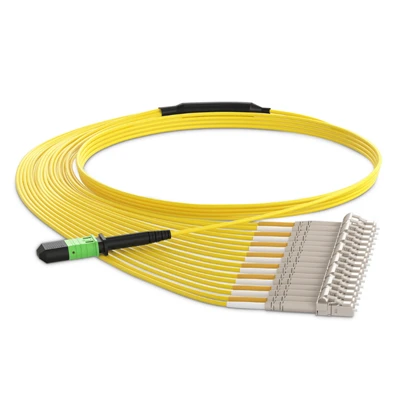
Let’s wrap this up with what you should take away. An APC fiber pigtail is a pre-terminated short fiber with an 8-degree angled polished connector, designed to minimize signal loss and back-reflection in high-stakes single-mode fiber applications. It’s the unsung hero of telecom, FTTH, data centers, and more – the little part that keeps your internet working, your data flowing, and your network running smoothly.
Fiber Optic Connectors If you’re working on a project that needs reliable, low-loss fiber connections – whether you’re a network tech, a telecom contractor, a data center manager, or anyone who depends on optical fiber performance – let’s chat. We supply high-quality, rigorously tested APC fiber pigtails in all common connector types (LC, SC, ST, FC) and lengths, and we can tailor orders to fit your exact needs. No generic, one-size-fits-all here – just the solid, dependable parts you need to get the job done right, on time, every time. Shoot us a message to talk pricing, bulk orders, or any questions you have about APC pigtails or fiber components in general.
References
- Keiser, G. (2011). Optical Fiber Communications (4th ed.). McGraw-Hill.
- Telecommunications Industry Association (TIA). (2018). TIA-568-C.3: Optical Fiber Cabling Standard.
- Miller, S. E., & Chynoweth, A. G. (Eds.). (1979). Optical Fiber Telecommunications. Academic Press.
- Hecht, J. (2015). Understanding Fiber Optics (5th ed.). Prentice Hall.
Shenzhen Dimi Telecommunications Co., Ltd.
As one of the most professional fiber pigtail manufacturers and suppliers in China, our products have good reputation in the market. Please rest assured to wholesale advanced fiber pigtail made in China here from our factory. Also, custom service is available.
Address: China
E-mail: sales@dimifiber.com
WebSite: https://www.dimi-fiber.com/
