If you’ve ever fumbled with a frayed charging cable while trying to drive, juggling a GPS between your knees and a dead phone, you know how much car wireless chargers change that small, messy part of daily commutes. As a supplier of these chargers, I get asked all the time: “How do these things work, anyway? Is it just magic, or is there actual science behind keeping my phone juiced up while I’m on the road?” It’s a fair question—especially because not all wireless chargers are created equal, and the ones that work well in a car have some unique twists your average desk charger doesn’t. Let’s break it down, no overly technical jargon, just the stuff that matters for anyone who uses (or sells) these devices. Car Wireless Chargers
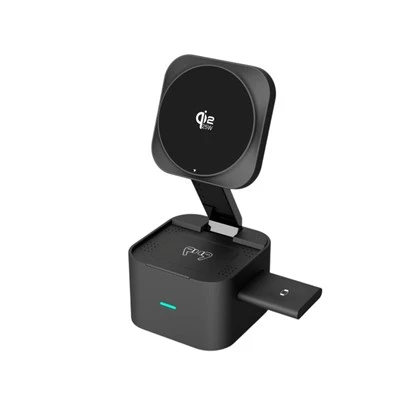
First, the core tech here is inductive charging, a principle that’s been around for over a century—way before phones and cars. If you remember basic physics from high school, Faraday’s law of induction says that when you run an electric current through a coil of wire, it creates a magnetic field. And if another coil is placed within that magnetic field, it can generate its own electric current from that field. That’s the foundation. For consumer wireless chargers, this translates to two sets of coils: a transmitter coil in the charger itself, and a receiver coil built into your smartphone (or a case add-on, if your phone is older).
But a standard desk wireless charger works on flat, stationary surfaces. A car is a whole different environment—your car is moving, vibrating, the charger might be mounted at an angle on a dashboard, and your phone could shift slightly in the cradle on bumpy roads. That’s why car wireless chargers aren’t just mini versions of the ones you use at home. There are two main types we provide as a supplier, and both solve those car-specific problems. The first is the air-core charger, which uses two copper coils (one in the charger, one in the phone) positioned close enough so the magnetic field can transfer power without any physical connection. The second is a newer magnetic charger, popularized by Apple’s MagSafe, which uses magnets to align the coils perfectly—critical for consistent charging in a moving car.
Let’s talk about alignment first, because that’s where a lot of bad car chargers fail. If the two coils are even a little off-center—say, your phone slides down a tilted dashboard mount, or you set it on a flat pad at an angle—the magnetic field weakens, and charging slows to a crawl or stops entirely. That’s why we test every charger we ship with a range of phone sizes, cases (even thick, rugged ones people use for work), and mount positions. For magnetic models, the magnets aren’t just for sticking; they’re calibrated to line the transmitter and receiver coils within a millimeter or two, so even if the car hits a pothole, the phone stays locked in the right spot. For non-magnetic pad-style chargers, we add small alignment guides—little rubber tabs or textured grooves on the charging surface—to nudge your phone into place. It’s a small detail, but it makes all the difference when you’re in stop-and-go traffic and your phone isn’t moving around every time you hit the brakes.
Next, power transfer efficiency. Inductive charging isn’t 100% efficient—some energy is lost as heat, which is a big deal in a car. Car interiors can get hot in the sun, so a charger that runs too hot will not only waste power but also stop charging to protect itself and your phone. That’s why our chargers include thermal management systems: tiny thermistors that sense when the unit gets too warm, and adjust the power output accordingly. A lot of cheap chargers skip this, leading to overheating warnings on your phone or even battery degradation over time. We’ve tested our models to stay under 40°C (104°F) even after an hour of highway driving on a 90°F day, which is a standard we hold to because no one wants their phone dying from heat while they’re on a long drive.
Another key component is power regulation, specifically overvoltage and overcurrent protection. Your phone’s battery is designed to take a specific amount of power—too much, and it can shorten its lifespan or even become a safety hazard. Car chargers draw power from the vehicle’s 12V (or sometimes USB-C) outlet, but the car’s electrical system can have voltage spikes—when you start the engine, for example. Good car chargers have built-in voltage regulators that smooth out those spikes, so your phone only gets the steady, regulated power it needs. We also include overcurrent protection that cuts off power if something goes wrong, like if you accidentally place a metal object between the charger and your phone (a coin, a key) which could cause a short.
Wait, let’s clear up a common myth: wireless chargers don’t “suck” more power from your car than a cable charger, at least not when they’re designed well. The efficiency loss I mentioned earlier means a wireless charger might use a little more total power, but the difference is minimal—usually less than 5W, which is barely noticeable on a car’s alternator. Bad chargers, though, are inefficient, so they waste more power as heat, which can put a tiny extra load on your battery, especially if you’re running other accessories (seat warmers, GPS, a dash cam) at the same time. That’s why we source our components from reputable manufacturers, and every charger goes through a load test to confirm it doesn’t draw more power than the USB-C port is rated for.
Now, what about fast charging? A lot of people want their phone to charge as quickly as a wired cable, so car chargers that support fast charging (like Qi 1.2 or MagSafe) have a special chip that communicates with your phone to adjust the power output. The Qi standard, developed by the Wireless Power Consortium, is the global benchmark for inductive charging, and all our chargers are Qi-certified. That certification means they’ve passed tests for efficiency, safety, and compatibility with a wide range of phones—from iPhones to Samsung Galaxies to Google Pixels. Without that certification, a charger might work with one phone but not another, or charge too slowly. We prioritize Qi certification because it’s a guarantee for our customers that their charger will work consistently, no matter what phone they have.
There’s also the question of mounting, which is part of how the charger works in a car context. We offer two main mounting styles: vent mounts and dash mounts, both with built-in chargers. Vent mounts clamp to the car’s air vent, keeping the charger in a spot where the phone is easy to see for GPS, and some even use the vent’s air flow to cool the phone while charging—another big plus. Dash mounts sit on the dashboard, often with a adhesive base for stability, and they’re good for larger phones or phones with thick cases. Both mounting styles have adjustable arms, so you can angle the phone to avoid blocking your view of the road. The charger itself is integrated into the mount, so the coil is positioned right behind where your phone sits, eliminating alignment issues that come with a separate pad on the dash.
I’ve seen firsthand how a bad car charger can ruin a commute. Last year, a customer reached out saying their old charger would only charge when their phone was perfectly level—so every time the car turned, the charging would stop. We sent them one of our magnetic chargers, and they wrote back a month later saying it worked even when their phone was tilted at a 30-degree angle, no interruptions. That’s the real value here: it’s not just about the tech, it’s about adapting that tech to the messy, variable space of a car. A desk charger can ignore vibration and angle, but a car charger has to work with all that, and that’s the part that makes our products different.
If you’re a fleet manager looking to outfit your company’s vehicles, a retail store wanting to add chargers as a customer perk, or an automotive accessory brand looking to source reliable wireless chargers, I can help. We work with businesses of all sizes, from small local garages to large national delivery fleets, and our chargers are designed to stand up to daily use—vibration, temperature changes, frequent plug-and-play with different phones. We test every batch before shipping, so you know you’re getting a product that works as advertised, not one that fails after a few months. Whether you need a bulk order of magnetic chargers for your team or a custom solution for a specific vehicle model, we can tailor it to your needs.
If you’re ready to discuss your requirements, place a bulk order, or just ask more about our chargers, reach out to our team to start a conversation. We’re here to help you find the right solution that fits your needs, whether that’s for personal use, your business, or your retail space.
Wireless Charger References
- Wireless Power Consortium. (2023). Qi Standard v1.3: Core Specification.
- International Organization for Standardization. (2022). ISO 14577: Indentation Test for Hardness and Other Mechanical Properties.
- Society of Automotive Engineers. (2021). SAE J2953: Wireless Power Transfer Systems for Light-Duty Vehicles.
- IEEE. (2020). “Thermal Management Systems for Consumer Wireless Chargers in Automotive Environments.” Transactions on Consumer Electronics.
KOMOS Co., Ltd.
As one of the most professional car wireless chargers manufacturers and suppliers in China, we are committed to providing high quality custom service and OEM service. Please feel free to wholesale bulk durable car wireless chargers at competitive price from our factory. Welcome to contact us for quotation.
Address: 4th Floor, Building 3, Zhongxi Buchong Community, Shajing Street, Bao’an District, Shenzhen City, Guangdong Province, China 518104
E-mail: contact@komos-tech.com
WebSite: https://www.komos-tech.com/
